Why You Should Write Technical Blogs (and How to Start)
A guide on why technical blogging is one of the best investments you can make in your career, along with practical tips to get started.

One of my favorite hobbies outside of work is sharing technical knowledge through blog posts. Over the years, writing has opened doors I never expected: speaking at AI meetups, opportunities to author books with famous publishers, and countless LinkedIn conversations that turned into opportunities. In this post, I want to share why I think every technical person should consider blogging, and give you some practical tips to get started.
My blogging setup

I publish on my personal website, which I host through GitHub Pages and build using Quarto. Jupyter notebooks are my tool of choice for writing since they let me mix text, code and output of that code. Quarto handles converting them into HTML. After letting a post sit on my site for a few days, I cross-post to Medium for greater visibility.
My posts focus on AI, ML, and Python development. I try to center my writing around real examples of the techniques I’m discussing so readers can gain practical knowledge they can apply to their own use cases. I typically write about:
- Niche techniques I use at work
- Emerging technologies (like generative AI lately)
- Topics I’m actively studying and researching
Five reasons to start blogging
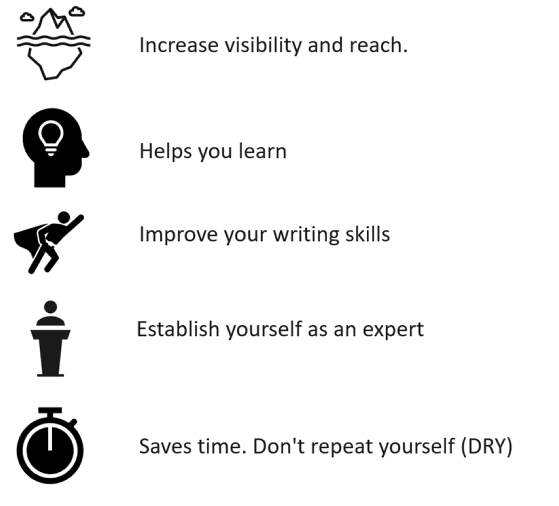
1. Increase your visibility and reach
Many people have reached out to me through LinkedIn or email asking about topics I’ve written about. Sometimes these turn into job opportunities. Blogs are like resumes, but better. They show what you actually know, not just where you’ve worked.
2. It helps you learn
Organizing knowledge forces you to synthesize your own ideas. One reliable test of whether you understand something is whether you can explain it to someone else. Writing a blog post is a great way to do that. I often discover gaps in my own understanding while trying to explain a concept clearly.
3. It improves your writing skills
The more you write, the more comfortable you become expressing your ideas. This carries over to work emails, design docs, and presentations.
4. Establish yourself as an expert
Through my writing, I’ve landed opportunities to present at local AI meetups, write books with well-known publishers, and review technical books before their release. None of this would have happened without a public body of work people could find.
5. It saves time (DRY principle)
Don’t Repeat Yourself applies to explanations too. Instead of spending two hours giving someone an overview of a topic, I can point them to an article. I also refer back to my own posts as notes, which saves me time when I need to refresh my memory on something I worked on years ago.
Tips for writing your first post
If you’re convinced but don’t know what to write about, here are some ideas that have worked for me:
Curate and comment: Make a list of links to blog posts, articles, or papers you like. Write brief summaries and highlight what you found useful. This is low-pressure and helpful to others.
Summarize what you learned: Attended a conference? Taking a class? Write up your notes and takeaways.
Turn emails into posts: Any technical explanation you’ve written more than once in email or Slack should become a blog post.
Write for yourself from a year ago: You’re best positioned to help people one step behind you. Your background, your style, and your knowledge level will give a different perspective than existing tutorials.
Answer: what would have helped me six months ago?: Think about problems you struggled with and write the guide you wish existed.
Don’t be a perfectionist: Post your writing sooner rather than later. Waiting just builds pressure and you end up writing less. You can always update posts later.
- Why you (yes, you) should blog by Rachel Thomas
- Show Your Work!: 10 Ways to Share Your Creativity and Get Discovered by Austin Kleon
Getting started
You don’t need a fancy setup. GitHub Pages is free. Quarto or Jekyll can turn markdown or notebooks into a website with minimal configuration. Medium works fine if you just want to write without managing infrastructure.
The hardest part is starting. Pick one thing you learned recently and write 500 words about it. That’s it. You can refine your process after you’ve published a few posts.
I hope you enjoyed reading this. If there is any feedback on the blog post, feel free to reach out on LinkedIn.